Thursday, December 19, 2013

Art Event Two

For my second art event I went to Natalie Jeremijenko' presentation on her own artwork. Natalie is an artist and engineer who is currently the director of her own work, called the "X Design" Environmental Health Clinic. She describes herself as a thinkger, meaning she brings her engineering talent into her artwork as well. She was born in Queensland, Australia in 1966 and was one of ten children in her family. She has a background in physics, biochemistry, neuroscience, and precision engineering. Natalie's work primarily focuses on the relationship between the environment, people, and technology. Her work for her X Design allows her to experiment with the opportunities new technologies gives society and allows non violent changes in the world. She is currently Natalie is a visiting professor at Royal College of Art, London and an artist not-in-residence at the Institute for the Future.

greenlight_l

Natalie's main experiments focus on her X Design Environmental Health Clinic. The X Design Environmental Health Clinic is modeled after other health clinics around the world. The difference in her clinic is that people come in to voice their concern over environmental issues instead of their own issues. When they leave, they are given a referral to different projects around the area that can help with their particular concern over the environment. It is entirely up to the person's concern whither they want to listen to the advice given or not, just like it is up to a person to help themselves if they want to quit smoking or drinking, etc. One project the X Design Clinic has created is the "GreenLight". This project was created for people who want to introduce more environmentally friendly lighting in their homes. It is a product based off the distribution of lights that are able to diffuse light through a natural process of photosynthesis. It is a project to improve the air quality of homes throughout the country. 


Another project of the X Design Clinic is the "Robotic Geese" experiment. This is where patients are able to take a robotic goose created by the clinic and take it out to ponds or lakes and interact with real geese or swans in a way that people normally can never do. They can "talk" to the geese using their own words or using pre-recorded sounds. Overall, I found Natalie's work very interesting. She was very involved in the biology aspect of the environment which I am also interested in. Her projects are all very environmental friendly and could one day become major projects that could affect the country or even the world. Until then, she should keep developing new ways to help the environment in interactive ways that allow society to become more involved in her experiments as well. 

Saturday, November 23, 2013

Art Event 1

I went to Todd Forsgren’s talk and it ended up being very interesting to me personally. Todd is an artist with a background in biology and, majoring in biology myself, I found his talk very interesting. Todd went to Bowdoin College to major in biology and ended up receiving a bachelor’s degree in biology. He focused his studies on the ecological areas in biology and while doing research in the field discovered his love of photography. He found it much more interesting than biology, although he still retained many biological aspects of biology in his art and was still interested in learning more about biology. He received his visual art bachelor’s degree from the same college and went on to earn his post-baccalaureate degree from the School of the Museum of Fine Arts in Boston. He has taught at many different colleges, including St. Mary’s, and is on many different academic boards throughout the country.


Todd’s art focuses on ecological aspects of biology and perceptions of landscape. He wants to create a type of art where natural history and art history are combined into one piece. One of his subjects in photography is ornithological pieces. In these pieces he used birds and portrayed them as being caught in web-like structures. These web-like structures were types of nets created by scientists that could not harm the birds and were meant to be able to capture the birds for studies. Todd would take pictures of the birds in certain positions that one wouldn’t normally see a bird in naturally. After taking photography in Australia for a while he decided to try and visit a more industrial place and went on to do more projects in places like Boston. He found it interesting that, even though they were surrounded by buildings, there were still some natural aspects in the city when he found many types of natural gardens.


I found many of Forsgren’s pieces very fascinating. The fact that almost all of his work involved the natural aspects of the world was amazing to me because you don’t see too many artists focus so much of their time and attention on natural things. I found his ornithological pieces very interesting because of the way he captures the birds. His photos almost make it seem as though the birds are drawn because of their precarious positions in the net and the unnatural positions they are in. Because of the lack of surrounding area in these pieces, it allows you to put all of your focus on the bird which is what I believe he wanted. You can see the texture of the individual feathers and the stimulating colors of certain birds. I enjoyed Todd’s work very much because I was able to relate to it so well. It stimulated my interest in biology even more and made me think more about the natural beauty of our world and the fact that some of us don’t even realize what’s there at our disposal.

Web Designer Blog

Brett Gullan is a principle consultant and creative director of Brett Gullan Communication + Design. He has had experience in graphic and communication design, printing, and new media technology. He has worked for companies all over the world for advertising and design studios. Brett is currently a member of the Hong Kong Designers Association and the American Institute of Graphic Arts. He received a Diploma of Art in graphic designs and a Master of Design in graphic communications. He has also received formal training in photography, computer science, and project management.


Brett has worked in many different categories of web design but focuses his interest in media and advertisement. He has many projects with creating advertisements and web sites for businesses and creates very interactive sites because of his background in graphic design. He believes communication is the key to everything and wants to be able to communicate with his audience through the web sites he creates. Brett likes to use social media in many of his websites because he believes social media sites are the key to the future. When creating advertisements for companies, Gullan can create a wide variety of designs and does not have any typical style to his work. He does what the company wants him to do in his own way.


I really enjoy some of the interactive sites he creates. Each one is very unique and nothing like any of the other sites. Some of his sites involve the use of 3-D modeling to show the inside or outside of a building. Others use backgrounds such as pyramids or waterfalls and allow you to go into them to view the inside of the structures. Gullan's work involves the use of so many ideas and designs and it is amazing that each design can be so different and unique to another site.

Thursday, November 21, 2013

Wednesday, November 6, 2013

Final Vector Project

Final Edit 

Identify Yourself

This blog was a very distracting, yet interesting, blog. It was very unique in the sense that it had that weird column scroll on the right side that was a little confusing at times. While reading I did not really understand what the point of the right column was at first and then I thought that maybe it was about the same topic as the section next to it just from a slightly different perspective. Then again maybe I'm completely wrong. This article, to me, was about technology being associated with our everyday lives and how we can do pretty much nothing to prevent it from taking control. Krystal South goes on and on about how our lives become so intertwined with technology that things we don't even mean to put on the internet can appear there without us ever knowing they existed. This could include pictures or very personal information about yourself.

I analyzed the section titled LIFE=GAME and GAME=LIFE. I play computer games a lot so this was one of the sections that interested me most. I tend to play video games mostly involving soccer and I have never really played Sims all that much. But I do know people who are obsessed with playing the game and know that it can pretty much take control of their lives completely. They tend to live out their wildest dreams in the game instead of taking the time to pursue the dreams in real life. They think they cannot do it without even attempting to try and decide that it would be better if they just pretended to live out their goals in a video game. To me this seems like a way of escaping their reality because they don't think very highly of themselves. In the section GAME=LIFE South is telling us about how she escapes her troubles by playing video games. This goes along with my theory about people taking the easy way out and playing out their lives through video games instead of going out and actually doing things. She also compared how playing against real people in video games can relate to the real world as well. You need to constantly think about new ideas and evolve new strategies to get through gaming situations.

Overall, I enjoyed this reading because it  can relate to almost everyone on the planet. Our lives are constantly being affected by technology whether we want them to be or not. Technology is something that people born after our generation grew up with from the time they were born. Eventually our lives may end up being just one big simulation in a game and we won't even have to get up our of our chair from the basement in our parents' house.

Wednesday, October 23, 2013

Vector Artist Post

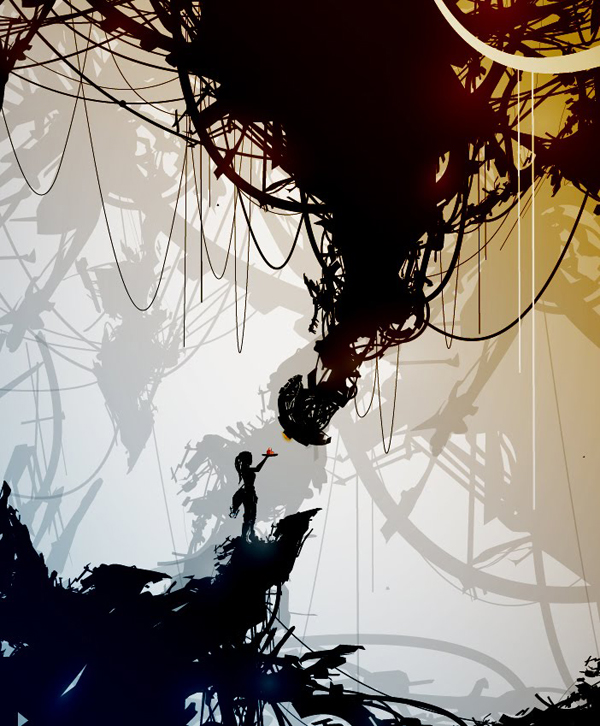
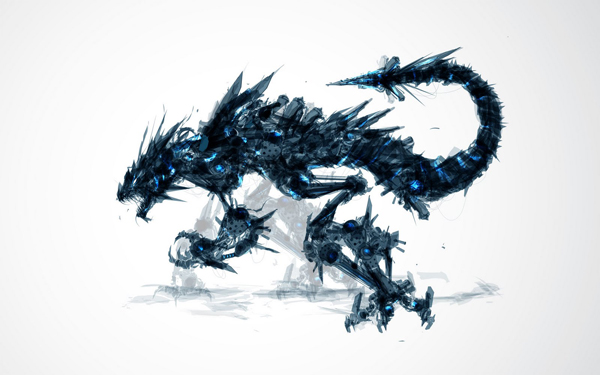
Justin Currie is a Canadian vector artist who grew up without television on a small farm in the middle of nowhere. Because of this he played with Legos as a child and grew up creating and designing more things than most people do in a lifetime. As a teen in high school, he found that he liked to drift off in class and doodle and sketch on his homework assignments instead of actually completing them. During his senior year he realized that he loved art and wanted to do something with art in his life. After graduating from high school, he moved to Winnipeg to begin Red River's Graphic Design diploma course. He graduated from the advanced degree in the program and began working for various design firms while working freelance illustrations on the side. He began working more and more with the freelancers and realized he loved illustrating and was picked up by a local video game company as a Concept Artist. He currently works at Complex Games as a concept artist and interface designer.


Justin prefers to work in illustrator and has created many creative designs for various companies but has mostly worked with video game designs. He also creates children's books and loves to work with abstract ideas and character concepts for a graphic novel. He spends most of his time between working with pictures in Photoshop and working with vector paintings in Illustrator. He loves to work with new concepts though, and loves to try new programs because he believes you should always keep your mind open so your work can continue to develop. When it comes to vector art, his artwork relies on the ability to take the same groups of shapes and use them multiple times, in multiple sizes. He coins his work as "Shattered Vector Painting" as it has a shattered glass type feel to it. 


The reason I decided to write about Justin was because of the very first art work I saw of his. His vector art is the basis for a lot of video game designs and I found those vector pieces extremely interesting. His "shattered" style of art is something I have never seen before and I am very interested in learning more about it. His other work also interests me like his graphic novel pieces but not as much as his vector art. The way he creates a "glassy" feeling to his work is such a new and innovative way of creating people and creatures. Many of the things he creates are not people, but fantasy-like creatures that one can only imagine. The way he brings them to life and makes them so realistic is fascinating to me and I plan on following Justin in the future to see what other creatures he can create using Illustrator. 

Monday, October 7, 2013

Computer Artist Blog

Charles Csuri is considered a pioneer in the field of computer graphics and computer animation. He created his first computer art project in 1964. He has been honored with the name the "father" of computer animation and digitial art by Smithsonian magazine. The Museum of Modern Art and The Association for Computing Machinery Special Interest Group Graphics have named him a leading pioneer of computer animation. He works with mostly computer animation, but has done projects in many other digital categories. He has recieved the 2000 Governor's Award for the Arts for the best individual artist and The Ohio State University Sullivant Award. Csuri is currently a professor Emeritus at The Advanced Computing Center for Art and Design at Ohio State University.

image five 
 
Csuri has done many different kinds of projects involving computer animation and digital media. One of his projects was with analogue computers. He wanted to digitally construct a real painting using his own variations of pantography. He would alter the device to the point where he could scale his artwork in a vertical or horizontal scale. Another one of his projects was real-time interactive objects. He would basically create an image with a computer and then bring it to life to interact with someone who was observing the piece. This may not seem very special but he was one of the first people to even get this kind of idea to work on the computer. He wanted the piece to not only include what he created, but to include the viewer as well. He wanted people to feel as though they were also part of the creation. Csuri also created algorithmic paintings. This was one of the first ever 3D paintings made on a computer. He would take something he created and bend its legs, arms, hands, or any other body part to try and create a sense of space. He would then use a different software to modify the figure's structure. This would usually mean that it would have holes or missing pieces. He created these digital pieces just like a sculptor would create physical works of art.
 
Distant Memories
 
I thought Csuri was a very interesting artist. I was amazed to find out how he modernized so many things involved with the digital world. I find his work very interesting because he uses so many different concepts in his pieces. He basically pioneered the digital world and is one of the reasons why we are able to do so many things with computers today. I didn't really find anything that did not interest me in his work because he was so diverse. I think Csuri is one of the most interesting artists I have heard about and plan on looking more into his work in the future.


Monday, September 23, 2013

Digital Artist Blog

Marcin Jakubowski is a freelance concept artist and illustrator who first began playing with digital art in the 90's. He was so enthusiastic about this new concept that he taught himself how to use it and has become a very successful artist. He says that his work is inspired by others and he prefers to use the "mood and atmosphere" around him to inspire his work. He lives in Poland and, being a free lancer, he works for whoever hires him. He particularly loves working on game and movie concepts and has received many awards for his collections including his "Beauty and the Beast" piece he submitted to the 2D Battle Event.

Snatch 

Jakubowski is very interested in gaming and film ideas for his work. He uses his own imagination along with others' work to create his own pieces. When he wants to create a new piece he wants that piece to represent a completely different world than his other pieces. He wants each individual piece to be a completely different concept than the last. He has used Photoshop for more than half of his pieces which is amazing because some of his creations look so professionally done that they look like they were done by a team of gaming designers instead of one man on Photoshop. Many of Jakubowski's pieces have a very futuristic look to them. He tends to have a very sci-fi feel to his work and likes to use robots and futuristic technology. He also creates cartoon characters for television commercials that are very "Disney-esk".

Digital Artwork from 5 Inspiring Artists

I find Jakubowski's work very interesting. I love video games where there is an apocalyptic theme to them and find them very fun. His work is so detailed which is very impressive considering he uses Photoshop for many of the pieces. All of his pieces, at least to me, were very impressive in detail and design and I believe anybody looking at them for the first time would be impressed with his aesthetic abilities. The only problem I can see in his pieces is the repetition. He says that he wants to create a new world in each of his pieces but to me they all seem to have the same kind of theme to them. The video game concepts are all very futuristic and apocalyptic to me while the commercial pieces seem very childish and too kid friendly. Other than the repetition I do enjoy all of his artwork and am planning on following him in his future endeavors.  

Sources:
http://inspiredm.com/digital-artwork-from-5-inspiring-artists/
http://www.balloontree.com/index.html


Tuesday, September 17, 2013

Monday, September 16, 2013

Collage de Scans

Just a fun thought I had of clothes

24 Hour Technology Log

Sunday, September 15th

9:00am - Woken up by phone
9:02am - Play on phone
9:44am  - Make breakfast with oven/refrigerator 
10:00am - Play on phone
10:32am - Text
11:00am - Watch TV for an hour
12:02pm - Play on phone
12:34pm - Text
1:00pm - Run on treadmill while listening to music on phone
2:00pm - Drove car
2:22pm - Answer phone call
3:09pm - Watch more TV
4:10pm - Text
5:10pm - Swipe One Card to eat
6:32pm - Did homework on computer
9:46pm - Watch TV and play on phone
11:06pm - Set alarm on phone

Wednesday, September 4, 2013

Dieter Huber

Dieter Huber is a contemporary digital artist from Austria. He began his career by studying stage design and theater art painting at the Mozarteum University in Salzburg. He is currently involved in many different projects, such as public collections in many areas of the world including Madrid, Frankfurt, Basel, and many other areas. He also participates in art fairs with his own designs including one of his more famous pieces "Klone". Along with his art fairs he has made publications in many different art magazines and has been the curator of many different art exhibits. He has various grants for artists everywhere and currently resides in Vienna.

Huber incorporates more natural aspects of the world in his work including humans, plants, and landscapes. He connects biotechnology with engineering to create a constantly changing organism that needs to adapt to new technologies. He is able to mutate whole plants and humans, or just parts of them, into new and never-before-seen artificial forms. Huber is able to do something that biologists cannot even imagine because of obvious restraints in technology. He is able to broaden the mind to completely new possibilities with his artwork. If biologists or engineers followed artwork like Huber's, they could be inspired to create these kinds of things in real life and not just through the computer.

Certain aspects of Huber's "klone" are very beautiful and unique. His landscape pieces are more appealing to the eye rather than his mutated plants and humans. While they are unique in their own way I do not believe people would really be interested in learning more about them because of their grotesque shapes. Huber's landscapes have a perfect composition and look exactly like the real things. Not knowing that he created them digitally, nobody could guess that those were not real places. His other pieces involve many combinations of plants of human parts and shaped into many different designs. Because he combines and mutates many different things, there is no consistent shape to his pieces. Huber's artwork is very interesting in a scientific sense but to a regular viewer, the pieces would seem very strange and not aesthetically pleasing.

Sources:
http://www.dieter-huber.com/biography-1997.html